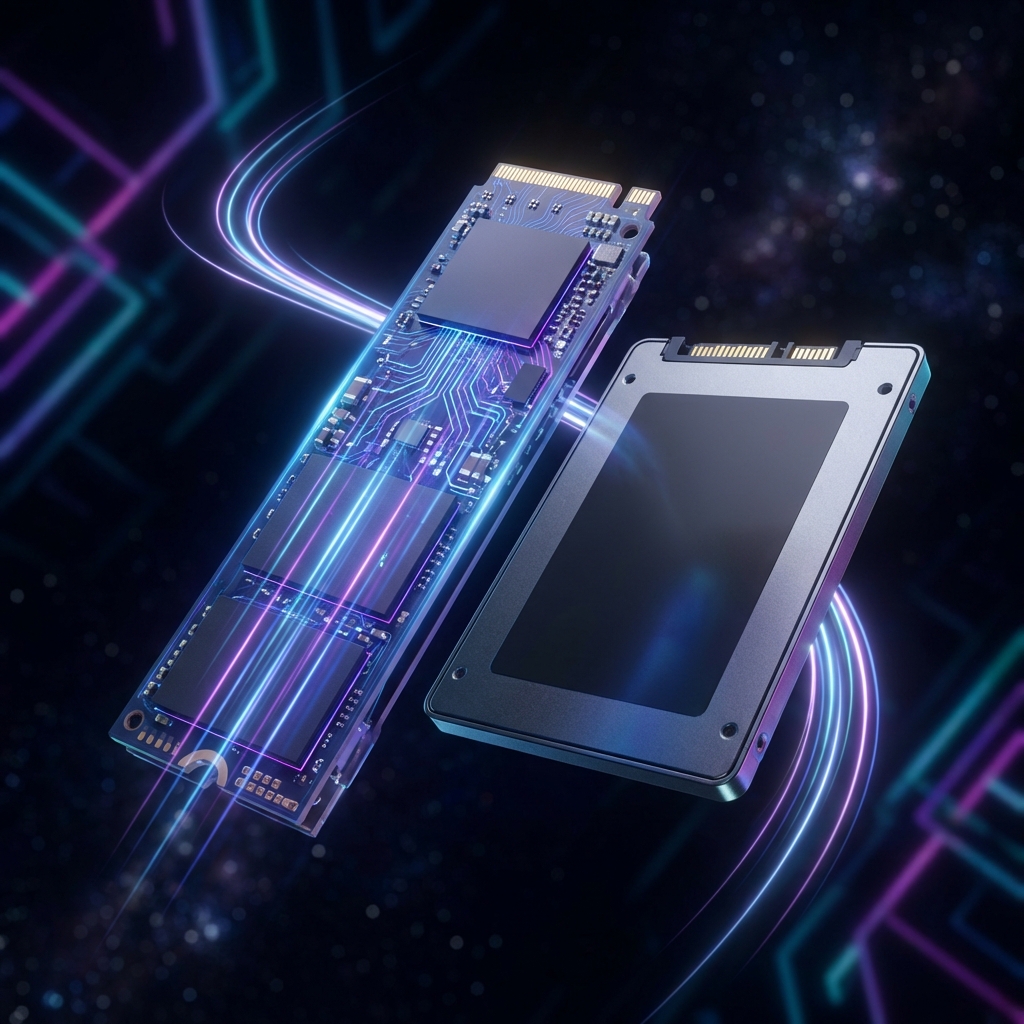
Storage speed is often the single biggest bottleneck in server performance. Moving from spinning Hard Disk Drives (HDD) to Solid State Drives (SSD) was a revolution, but the shift from SATA SSDs to NVMe (Non-Volatile Memory Express) represents another massive leap.
The Interface Limit
Traditional SSDs typically use the SATA interface—disconnecting the spinning motor but keeping the legacy communication protocol designed for hard drives. SATA III caps out at roughly 600 MB/s. No matter how fast the flash memory is, the cable can't carry data faster.
NVMe drives connect directly to the CPU via the PCIe bus, bypassing the SATA controller entirely. This unlocks speeds of 3,500 MB/s (PCIe Gen3) to over 7,000 MB/s (PCIe Gen4). More importantly, NVMe reduces latency drastically and handles parallel commands far better than SATA ever could.
IOPS and Latency
Sequential speed (large file transfers) looks good on spec sheets, but IOPS (Input/Output Operations Per Second) matters more for servers. A SATA SSD might deliver 80,000 IOPS; an enterprise NVMe drive can push over 500,000 IOPS.
For database servers, this difference is transformative. High-traffic databases processing thousands of small transactions simultaneously see massive gains from NVMe's low latency and high parallelism.
When to Choose Which?
Use NVMe for:
- Database servers (MySQL, PostgreSQL, MongoDB)
- High-frequency trading platforms
- Virtualization hosts running many VMs
- Content creation workstations
Use SATA SSDs for:
- Web servers with static content
- Boot drives for application servers
- Cost-effective "warm" storage tiers
While NVMe costs have dropped, they still command a premium. Matching the storage technology to the workload ensures you pay for performance only where it actually impacts results.