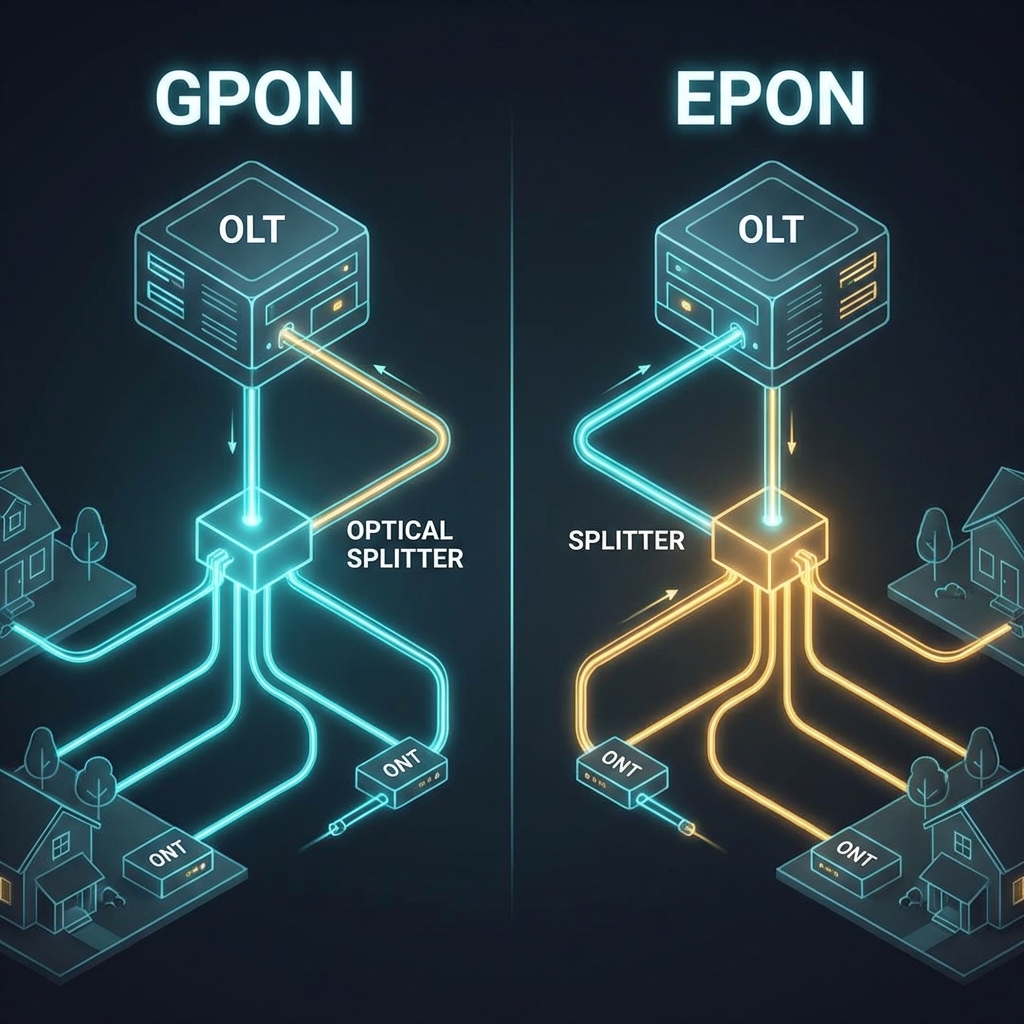
Choosing between GPON and EPON represents one of the most consequential infrastructure decisions for fiber-based ISPs. Both technologies enable passive optical networking, but their technical differences create distinct advantages for different deployment scenarios.
Technical Foundations
GPON (Gigabit Passive Optical Network) operates on ITU-T G.984 standards, delivering 2.5 Gbps downstream and 1.25 Gbps upstream. It uses ATM and GEM encapsulation, providing sophisticated QoS capabilities that prioritize traffic types effectively. GPON's architecture supports split ratios up to 1:128, though 1:32 or 1:64 configurations are more common in practice.
EPON (Ethernet Passive Optical Network) follows IEEE 802.3ah standards, offering symmetric 1.25 Gbps speeds. Its Ethernet-native protocol simplifies integration with existing network infrastructure and reduces protocol conversion overhead. EPON typically uses 1:16 or 1:32 split ratios.
Cost Considerations
EPON equipment traditionally costs 30-40% less than equivalent GPON hardware, making it attractive for budget-conscious deployments. However, this gap has narrowed as GPON has matured. The total cost analysis must include not just equipment but also operational complexity, power consumption, and scalability requirements.
Performance Trade-offs
GPON's asymmetric design suits residential markets where downloading dominates usage patterns. Its superior QoS mechanisms benefit providers offering voice, video, and data triple-play services. EPON's symmetric architecture better serves business customers and scenarios requiring significant upstream capacity.
Regional Adoption
GPON dominates in Europe, North America, and India, driven by telecom operator preferences and vendor ecosystems. EPON remains prevalent in Asia Pacific, particularly in China and Korea, where the IEEE standard gained early traction.
The "right" choice depends on your specific market, existing infrastructure, and long-term service roadmap rather than inherent superiority of either technology.