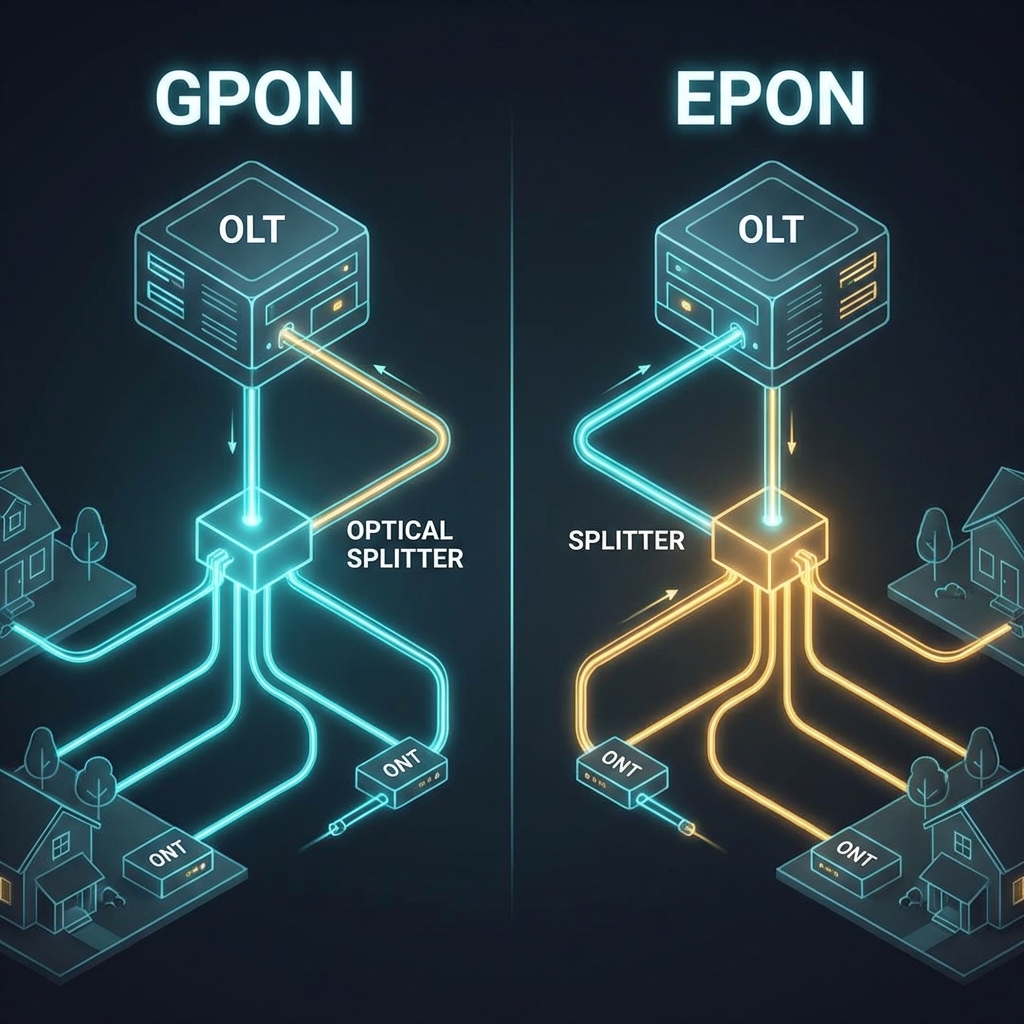
Splitter ratios fundamentally shape PON network economics and performance. Higher split ratios reduce fiber and OLT port costs by serving more customers per port; lower ratios preserve bandwidth per subscriber. Finding the optimal balance requires understanding both immediate costs and future capacity needs.
Understanding Split Ratios
PON architectures use passive splitters to divide optical signals from a single OLT port to multiple ONTs. Common ratios include 1:8, 1:16, 1:32, and 1:64. Each doubling of split ratio halves per-subscriber bandwidth while reducing per-subscriber infrastructure costs.
GPON supports theoretical 1:128 splits; practical deployments rarely exceed 1:64 due to optical budget constraints and bandwidth considerations. Distance between OLT and ONT limits achievable split ratios—longer distances require more optical power per subscriber.
Bandwidth Implications
A GPON port delivers 2.5 Gbps downstream shared among all subscribers on that splitter. At 1:32 split, each subscriber theoretically accesses 78 Mbps if all subscribers demand bandwidth simultaneously. Statistical multiplexing means actual experience is usually better, but contention remains real.
Business services often warrant lower split ratios—1:8 or 1:16—to ensure consistent bandwidth. Residential deployments typically use 1:32 or higher where cost efficiency outweighs performance concerns.
Staged Splitting
Cascaded splitter configurations use multiple stages. A 1:4 splitter at the central office feeding 1:8 splitters at distribution points achieves effective 1:32 ratio while placing equipment closer to subscribers.
This approach facilitates incremental deployment. Initial builds serve nearby customers; distribution splitters extend reach as subscriber density justifies investment.
Future-Proofing Considerations
Today's acceptable split ratio may constrain tomorrow's services. 4K video streaming, cloud gaming, and symmetric business applications increase bandwidth demands continuously. Conservative split ratios preserve headroom for service evolution.
Physical splitter replacement is expensive and disruptive. Installing higher-quality splitters and maintaining optical budget headroom enables future adjustments without truck rolls.